
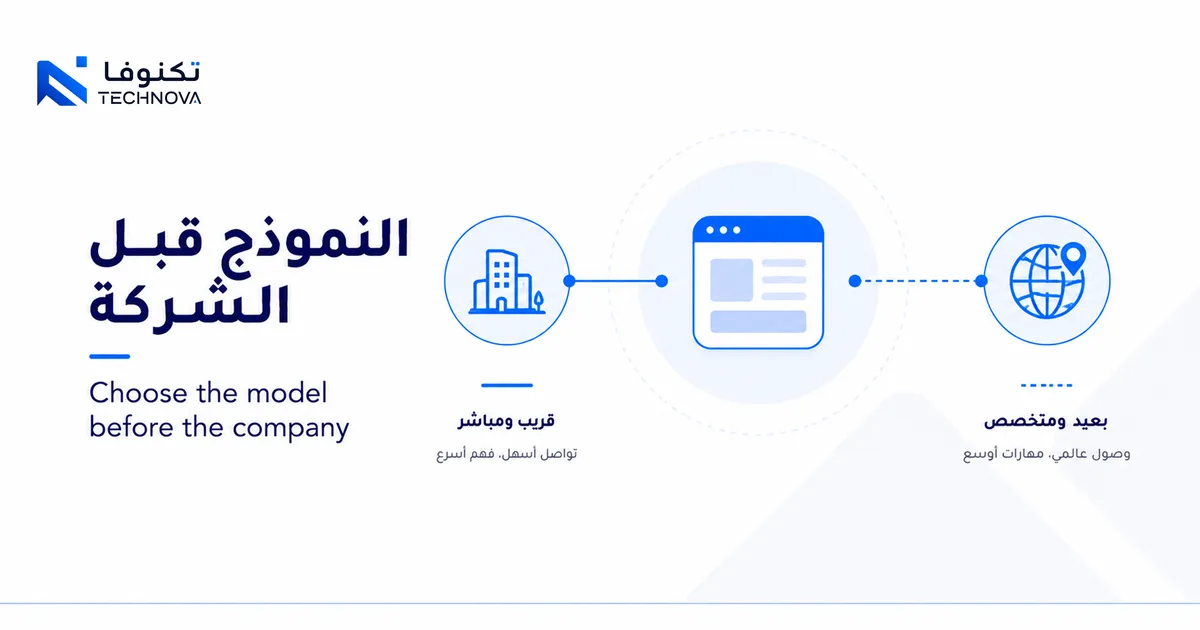
You choose between offshore and a local partner based on your project's nature, not its price: a local partner suits daily communication and market understanding, while offshore suits a rare specialisation or scaling a team quickly. The right decision starts with one question: what most threatens this specific project's success?
In this guide: the four delivery models, real cost structure, communication and time zones, code ownership, risks, when each model wins, testing a partner, and managing a distant team.
What delivery models are available to you?
The decision is not binary. You have four models, each with its place.
- Local partner: a company in your country delivering the whole project.
- Offshore: a company in another country, usually with a time and cost gap.
- Nearshore: a company in a nearby country with a small time gap.
- Dedicated team: engineers working full time with you through a partner.
Mixing the models is common. Many compare a local company to an offshore team, though they are different levels of commitment and management.
Decide the model first, then look for a company within it. Searching without a clear model makes comparison impossible.
What is the real cost structure of each option?
The quoted price is not the full cost. The real cost includes the time and management you pay from your side.
Offshore may quote a lower hourly rate, but adds hidden cost: longer management time, repeated explanation, and more reviews because context is distant.
A local partner may quote higher, but reduces management friction — which saves your own time, the most expensive thing you have.
- Count the build price plus your monthly management time.
- Add the expected rework cost from misunderstanding.
- Count the cost of delay on your business, not just the project.
Compare total cost of ownership, not hourly rate. The cheapest option can end up the most expensive.
How do communication and time zones affect your project?
Communication is the first point of failure in distant projects, more than technical skill.
A four-hour gap means a short shared window. Every open question can cost a full day waiting for an answer.
Cultural distance runs deeper than language. How a team says "no" or reports a delay differs between markets, and misreading it costs more than translation.
Do not assume every distant company communicates poorly, or that every nearby one is always available. Test the communication itself while negotiating — it is a sample of the future.
If your project changes often and needs daily decisions, proximity serves you. If its scope is clear and stable, distance does less harm.
Who owns the code and data in each model?
Intellectual property (IP) is often overlooked until a problem appears, and by then negotiating is late.
Require in writing that code and data are yours after full payment, whatever the model. This is not automatic.
- Define ownership of code, designs, and documentation explicitly.
- Ask for the repository and access credentials at every phase.
- Review where your customer data is stored and under which law.
- Agree on an NDA before sharing your business details.
Legal differences between countries make cross-border enforcement harder. Legal proximity is a value you only appreciate during a dispute.
What risks are specific to each model?
Each option has risks, and knowing them early lets you manage rather than be surprised.
Offshore risks: weaker daily oversight, team turnover without your knowledge, and harder legal follow-up in a dispute.
Local risks: fewer options in rare specialisations, possibly higher cost, and more dependence on one market.
The difference is not whether risks exist, but whether you can manage them. Choose the risks your current team can handle.
When is a local partner the more suitable choice?
Proximity wins when the project is unclear, changing, or tied to the local market.
- The project is in discovery and its scope is not stable yet.
- You need frequent meetings and fast face-to-face decisions.
- The product serves the local market and needs understanding of its customers.
- You need integration with local entities such as payments or invoicing.
- Your internal team is small and has no time to manage a distant team.
In these cases proximity is not a luxury but a direct success factor that reduces daily friction.
When is offshore the more suitable choice?
Distance wins when the scope is clear and the need is specialised or large.
- You need a rare specialisation unavailable in your local market.
- The scope is documented and stable and needs no daily decisions.
- You need to scale the team quickly for a defined period.
- You have a product or technical manager able to run a distant team with discipline.
Offshore succeeds with discipline in documentation and follow-up. Without them, the expected saving turns into rework cost.
What is the blended model and when does it suit you?
You are not forced into a full choice. Many companies mix both models intelligently.
The common shape: a local partner leads planning, communication, and quality, while a distant team delivers clearly scoped parts under supervision.
This gives you decision proximity with delivery flexibility, and lowers your management burden because the local partner carries it.
What matters is clear responsibility: one party accountable to you for the outcome, not parties trading blame.
How do you test a partner before full commitment?
Do not start a full project with a partner you have not tried. A limited test reveals how they really work at the lowest risk.
Start with a small paid phase: discovery, a prototype, or one module. What you see in two weeks is more honest than any presentation.
- Do they meet the agreed date on the small task?
- Do they report problems early or after they happen?
- Does code and documentation quality let someone else continue?
- Do they ask questions that show they understand your business?
A trial phase costs little compared with a full project that fails after months. Make it a condition before any long commitment.
How do you manage a distant team successfully?
If you choose offshore, your success depends on your management discipline more than their technical skill.
Distant teams need written clarity. What is not written is misunderstood, and what is misunderstood is built wrong.
- Document requirements in writing instead of verbal explanation.
- Set a fixed weekly meeting inside the shared window.
- Ask for small frequent deliveries instead of one large handover.
- Assign one person on your side responsible for questions and decisions.
Frequent delivery exposes drift early. Waiting until the end makes correction costly or impossible.
What questions reveal the model that fits you?
Before comparing companies, answer these honestly. Your answers set the model before they set the company.
- Do you know exactly what you want to build, or are you still exploring?
- How many daily decisions will the project need from you?
- Do you have someone to manage technical detail on your side?
- Does the product serve a market the distant company actually understands?
- What happens to your business if the project is two months late?
If most answers lean toward uncertainty and fast decisions, proximity suits you. If they lean toward clarity and stability, your options are wider.
How do you decide practically?
- Write your project scope and how stable it is.
- Estimate how many hours weekly you can give to management.
- Decide whether the product needs local market understanding.
- Calculate total cost, not hourly rate.
- Choose the model first, then compare companies within it.
An illustrative example: a company needs an app for local customers and the scope is not settled. A local partner suits the start until scope stabilises, then the team can expand if needed.
The governing rule: the more uncertainty, the closer you stay. The more clarity, the wider your options.
Related links
- How to choose a software company in Egypt?
- Product discovery and MVP build
- The markets we serve across the region
If you are deciding the delivery model for your next project, talk to the Technova team to discuss your scope and pick the model that fits it.


